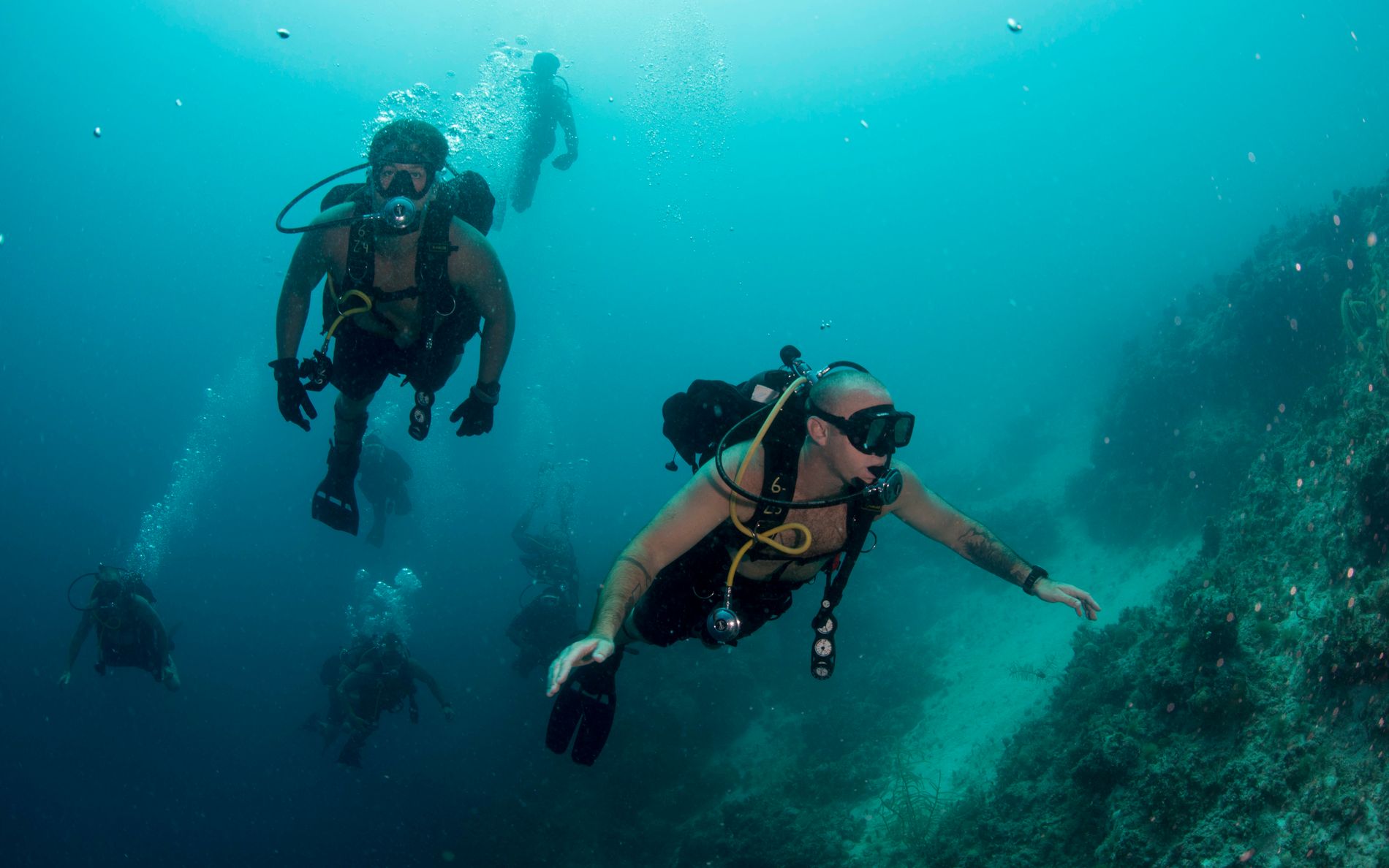
The Great Blue Hole dive is a deep, short descent to ice-age stalactites at about 130 ft, followed by two reef dives on Lighthouse Reef. Most operators want Advanced Open Water or logged deep dives for the full depth.
The Great Blue Hole dive starts on the shallow reef around the rim, about 30 ft down, then drops down the inner wall.1 The stalactites begin around 100 ft, where the wall cuts back under itself.2 Most groups go to about 130 feet (40 m), stay there for roughly 8 minutes, then make a slow ascent with a safety stop.3, 1 The whole dive takes about 23 minutes, and it is the first of three dives on a full-day trip.4
A typical profile, based on operator descriptions. Your divemaster sets the actual plan.
Who can dive the Great Blue Hole?
Most operators want Advanced Open Water, or a set number of logged dives, before they take you to the full depth of the Great Blue Hole dive. Open Water is the minimum, and each operator sets its own limits on certification, logged dives and how recently you last dived. PADI says it is not a beginner dive and recommends its Advanced Open Water or Deep Diver course before going to 40 m.1
Great Blue Hole dive requirements by operator
Operator
Requirement
Scuba Sensation
Minimum Open Water; 40 m only with Advanced Open Water or 25+ logged dives, otherwise limited to 24 m
Sunrise Scuba
Advanced Open Water: 40 m (130 ft); Open Water: 30 m (100 ft)
Amigos Del Mar (San Pedro)
Open Water or higher; a logged dive within the last 6 months to at least 80 ft, otherwise a local dive first
Requirements checked November 2026 on each operator's own site.4, 5, 6 If you're Open Water only, ask before booking whether you'll be limited to a shallower profile.
What you'll see, and what you won't
Divers on the Great Blue Hole dive swim among stalactites that start around 100 ft and hang from the ledges down to about 130 ft.2, 3 They grew in air, before rising seas flooded the cave. Our overview covers how the Great Blue Hole formed.
Sharks are likely on the Great Blue Hole dive but not guaranteed. Caribbean reef sharks are the most common, blacktip sharks turn up too, midnight parrotfish and groupers cruise the wall, and bull and hammerhead sharks are an occasional sighting. Visibility varies too: the water can be murky near the surface and clear deeper down, or the other way round.
You won't see much reef life inside the hole itself. There isn't enough sunlight for coral, so the walls carry feather duster worms rather than reef. Below about 300 ft, the Great Blue Hole's oxygen-free layer of hydrogen sulfide means nothing lives at all.7 The color on this trip comes on the second and third dives.
A Great Blue Hole dive day from Caye Caulker
A Great Blue Hole dive trip from Caye Caulker is a full day with three dives: the Blue Hole first, then Half Moon Caye Wall and the Aquarium at Long Caye.4, 5 The water is 79 to 84 °F at the surface and a few degrees cooler in the hole, so bring a 3 mm wetsuit if you feel the cold, and a dive light if you have one.
5:00 to 6:00 amLeave Caye Caulker
Meeting times run from 5:00 to 5:30; boats leave by about 6:00.
2-2.5 hrsThe crossing
Open water to Lighthouse Reef. Briefing on the way.
Dive 1Great Blue Hole
The deep dive to the stalactites at about 130 ft.
Dive 2Half Moon Caye Wall
A reef wall dive, then lunch on Half Moon Caye.
Dive 3, back 4 to 5 pmThe Aquarium
A shallower reef dive at Long Caye before the ride home.
How much it costs to dive the Great Blue Hole
Diving the Great Blue Hole from Caye Caulker costs US$355-370 per person, and all three Caye Caulker operators include the park fees. Cheaper headline prices elsewhere often leave tax, fees and gear to pay on top. Compare Blue Hole dive trips by departure point before you book.
Great Blue Hole dive trip prices
Leaves from
Price
Included
Caye Caulker
US$355-370
Park fees, three dives and lunch; gear and tax at most operators
San Pedro
US$285 + extras
Excludes gear, 12.5% GST and the US$40 park fees
San Pedro's US$285 becomes about US$361 once you add 12.5% GST (US$35.63) and the US$40 park fees, before gear rental and tips.6, 8 Prices checked November 2026.9
Some operators need a minimum group of 10 before the trip runs, so leave a spare day.
Is it worth it?
Diving the Great Blue Hole is worth it for the geology and the setting. At 130 ft the focus is the stalactites rather than fish, and the color comes later the same day at Half Moon Caye Wall and the Aquarium, where reef sharks, eagle rays and turtles are often seen.
Is diving the Great Blue Hole dangerous?
Diving the Great Blue Hole carries the risks of any deep dive to about 130 ft, so it suits trained divers who stay close to their guide. The main one is nitrogen narcosis, a drunk-like effect of breathing air at depth. Some divers feel it from about 100 ft, others not until 130 ft, and fatigue, alcohol, cold and anxiety make it more likely.10 It shows up as impaired judgment, overconfidence or drowsiness, and it clears within minutes of rising to shallower water.10, 11
The wall drops into water hundreds of feet deep, so good buoyancy control matters, and the time at depth is only about 8 minutes.3 Check that your dive insurance covers dives to 40 m before you go.
The crossing is 2-2.5 hours of open water each way, so take seasickness tablets before the boat leaves if you need them. For the calmest months, see the best time of year for a Blue Hole trip.
Questions divers ask
Can you dive the Great Blue Hole?
You can dive the Great Blue Hole on a guided day trip from Caye Caulker, San Pedro or Belize City if you hold at least an Open Water certification. Most operators want Advanced Open Water or a set number of logged dives before they take you to the full 130 ft depth.
How much does it cost to dive the Great Blue Hole?
Diving the Great Blue Hole costs US$355-370 per person from Caye Caulker, including park fees and three dives. From San Pedro the base price is lower (US$285), but tax, park fees and gear rental are added on top.
Is diving the Great Blue Hole worth it?
Diving the Great Blue Hole is worth it if you want a deep dive among ice-age stalactites, where the formations are the focus rather than fish. The reef dives that follow at Half Moon Caye Wall and the Aquarium are where most of the marine life is.
Will you see sharks on the Great Blue Hole dive?
You will probably see sharks on the Great Blue Hole dive, but sightings are not guaranteed. Caribbean reef sharks are the most commonly reported, blacktip sharks turn up too, and bull and hammerhead sharks are occasional.
How deep do divers go in the Great Blue Hole?
Divers go to about 130 feet (40 m) in the Great Blue Hole, roughly a third of its 410 ft depth, and spend about 8 minutes there before ascending.
Can beginners dive the Great Blue Hole?
Beginners fresh from an Open Water course usually cannot do the full Great Blue Hole dive, because operators want Advanced Open Water or logged deep experience. Scuba Sensation, for example, limits Open Water divers with fewer than 25 logged dives to 24 m (80 ft).
Prices, timetables and park fees on this site are compiled from operator websites and official sources, then checked and dated. Rankings are never sponsored, and affiliate links never change what gets recommended.